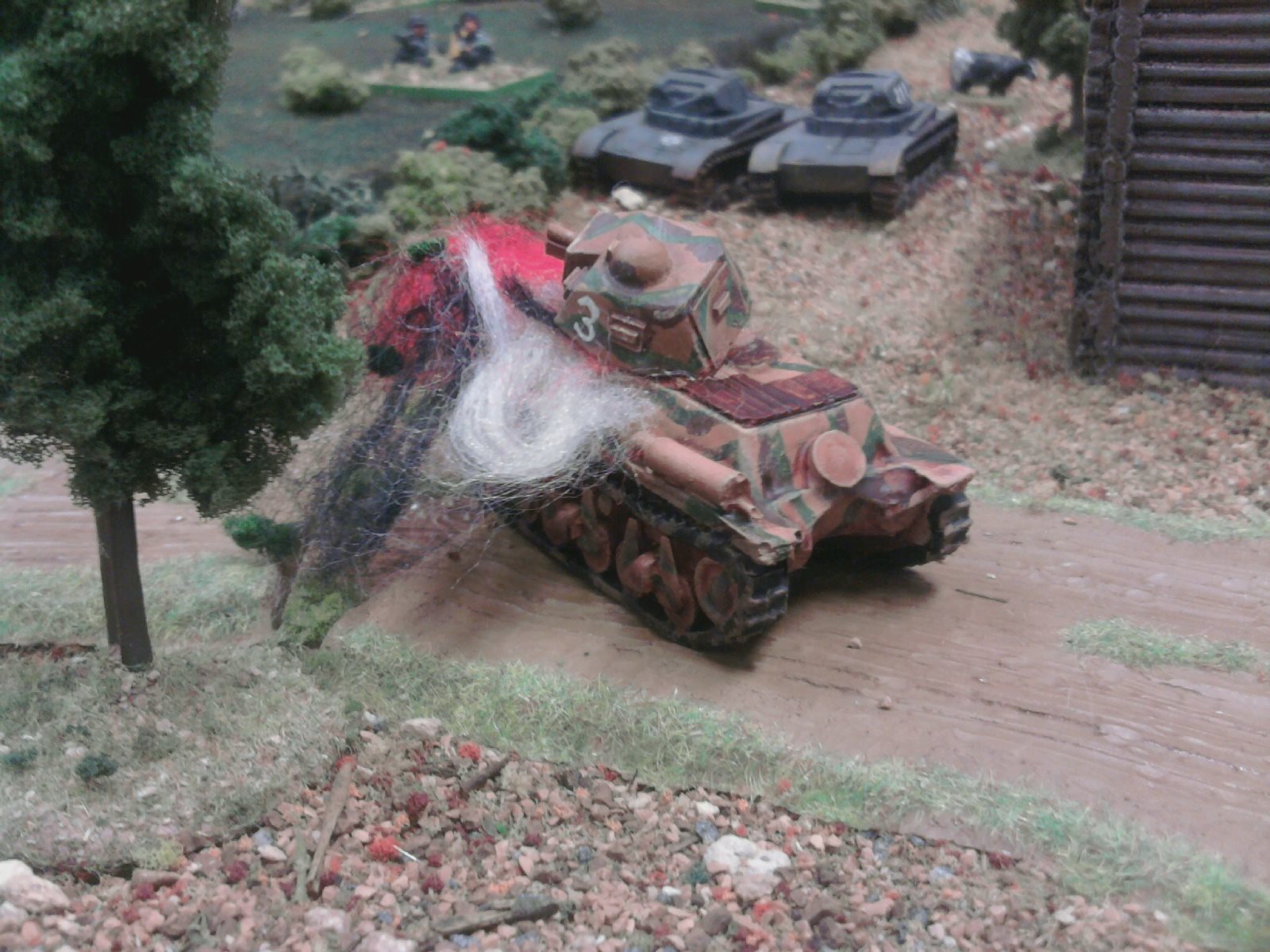
British Cromwell hunts Whittman!

British Cromwell hunts Whittman!
A pic from a Fireball game at Fall In 2010

Thursday, December 16, 2010

Japanese Invade Philippines 1941

Yesterday we playtested "A Filipino Welcome" - the first scenario of a series about the fall of the Philippines. What a blast! Here's the historical setup:

Date: December 22, 1941
At dawn the main Japanese invasion forces began hitting the beaches at five separate sites in Lingayen Gulf. Four of these were completely undefended, allowing the Japanese to race inland and cut the coastal road. Only at Bauang were Filipino troops waiting at the beach. Here the Headquarters Battalion, 12th Infantry (Philippine Army, led by American officers), with one .50-caliber and several .30-caliber machine guns, faced the oncoming Japanese. As the Kamijima Detachment approached the shore, the Filipinos opened fire.

And it was effective fire indeed! The Fil-Am forces had gambled and placed their .50 cal in a patch of scrub well forward - right on the beach - and it paid off. Lt. Col. Kamijima's Daihatsu landing barges were hit before they even reached the beach, and when the troops finally began spilling out, the majority were left cowering in the surf... or floating face down.


Only a handful of troops made it off the boats in good order. Unfortunately for the Filipinos, that's all the Japanese needed. Right away, they launched a Banzai charge against the .50 cal. (designer's note: the Banzai rules are VERY lively and a definite high point. A leader initiates Banzai, and he brings along with him all good-order subordinate troops in contact whether these have already moved or not. So it's extremely dangerous, and the feel of it matches the "suddenness" so often mentioned by defenders in written accounts.) This Banzai charge consisted of two squads and one platoon leader, and it suffered withering fire on the way in which killed the leader. However, both squads pressed onward (perhaps inspired by the late platoon leader's example), and they closed into contact with the Filipinos...


Next, by miraculous luck, the Filipinos prevailed in close combat! (thanks to Adrian Reen-Schuler rolling snake-eyes for his Japanese). What a wild fight!

The Filipinos now sensed blood in the water. Defenders from inland converged onto the landing site and pinned down the IJA with small arms, plus two .30 cal Browning machineguns. With losses mounting, the IJA scrambled to get troops off the beach. In ones & twos, their teams began to make it to a blind zone behind some scrub, hidden from Filipino fire. They gathered there and launched another Banzai charge inland toward one of the Brownings...


Despite more withering fire on the way in, this charge carried the position, wiping out both the Browning and another Fil-Am position immediately behind it. The Japanese were finally on the move. The bulk of the troops back in the surf were finally able to rally & get off the beach, and a battle of manuever developed in the dunes. There were 3 or 4 Banzai charges in total (I can't recall), but ultimately, the Japanese controlled only two of the three victory locations they need to establish the beachhead. Honors went to the Filipinos. Everyone had a blast with this one. The "feel" of the engagement seemed just right, and there were loads of tough tactical choices to be made on both sides.

Historically, Lt. Col. Kamijima suffered terrible losses at Bauang, and he might have been thrown back into the gulf entirely, but the Fil-Am defenders ultimately had to withdraw because other Japanese elements were threatening to cut the coast road behind them. In this scenario, that dynamic is represented through initiative chips. The Fil-Am forces have one permanent chip, but it's lost as soon as a good-order Japanese squad exits the board behind them, toward the coastal road.

We kicked around various refinements to the rules which might make the game better, (seemingly an endless process, but the results are worth it). Next time we play this one, we'll see how it goes.

This is the first of eight scenarios covering the Fall of the Philippines. The next represents the very first tank-on-tank fight for US forces in WWII, when M3 Stuarts of the 192nd Tank Rgt. faced Japanese armor at Agoo. This link has that story:

http://www.proviso.k12.il.us/bataan%20web/Morin.htm

In a later scenario, Lt. Ramsey's famous charge at Morong (the U.S. Army's final horse-cavalry charge ever) will be represented.

Cheers,
Jonathan Tristram Miller.

Wednesday, November 24, 2010

Banzai! Fireball Forward and the Pacific War

Last night the lead elements of the Ichiki Detachment clashed with a combat patrol from the 1st Marines west of Henderson Field. The Marines, led by Captain Charles Brush (played by Doug Austin), had a report that a Japanese patrol was headed his way and set his command of two under-strengthed rifle platoon and a machine gun section in a cordon defense to prevent Japanese infiltrators from reaching the airfield. The north part of his line covered two trails that led through a coconut grove while one platoon covered the jungle to the south. The Marines hunkered down and waited with fingers on triggers for the Japanese to appear. The platoon guarding the coconut grove (played by Bruce Weigel) decided to move out and either clear the area or make contact. They were making steady progress with no sign of the enemy until suddenly the sound of rifle fire broke out from the jungle to the south. The lead elements (played by Tom Garnett) from the Japanese force had entered the jungle in an attempt to outflank the Marine position. Here they ran into the USMC platoon commanded by Lt. Jacym (played by Latham Fell). Lt Jacym had been moving through the jungle himself and in doing so got his platoon strung out and disorganized in the unfamiliar terrain. But luckily one squad was in position to meet the Japanese. A firefight erupted which drew more Marines towards the action. Just then Capt. Shibuya (played by Tim Tilson) burst into the jungle leading two squads of crack troops. (see photo above) After firing a quick volley, Shibuya screamed BANZAI! and led his men forward into close combat with the Americans. A few BAR men in the jungle opened up on the screaming mass of Japanese but the fury of the charge was not to be stopped. Shibya's men overran the Marine squad giving them the bayonet. Stunned by this assault the Marines were unable to react and the lead elements of Colonel Ichiki's Detachment successfully navigated their way through the jungle and on to Henderson Field. Captain Brush realized that his line had been penetrated and decided to retire back to the Marine perimeter.

So went the first Pacific War scenario using Fireball Forward. Everyone had a great time and agreed that the game 'felt' like it was a Guadalcanal fight. Up until now we have been playing mainly Normandy, Russia and Sicily scenarios. Although they each have unique terrain features they are similar. Normandy had hedgerows, Russia has thick woods and fields and Sicily has cactus hedges....but other than that they are the same. Guadalcanal is totally different. Jungle, Coconut groves, Banyan trees, Kunai Grass and bare slopes all conspire to make the environment of the fighting a completely different experience than Europe and Russia. In fact that was the case during the war...the US was unprepared to fight in the jungle, at least at first.

Our goal in Fireball is to get at that 'feel' of a totally different environment without having to create alot of new or special rules. We are trying to tackle this as we develop the main rules and not do the Pacific as an afterthought in a supplement created later. The rules should work across the board for all types of terrain. (Which is why I am preparing to do North Africa scenarios next...North Africa being another place with totally different terrain challenges.) I think the way we are approaching Guadalcanal terrain is working and in the end we will have a great set of rules for jungle and a fun Guadalcanal scenario book. I also plan to try out some later Pacific stuff (Tarawa or Iwo) to make sure that works. And Jonathan Miller is creating a scenario book of the Japanese invasion of the Philippines, 1941. Can't wait!

Happy Thanksgiving!

Mark

PS - We do have rules of Banzai charges which everyone loved...even as I was explaining them the gamers could hardly wait to try them. (Eyes widened and I swear I saw the Japanese players starting to drool.) Congrats to Tim Tilson for launching the first successful Banzai charge of Fireball Forward!

Thursday, October 21, 2010

Fireball Forward at Fall In

Fall In will be at the Lancaster Host Resort next weekend (Oct 30) and there will be eight Fireball Forward games being run by a variety of people. Curt Daniels will be running three Russia '41 games that feature man vs tank actions from one of the Skirmish Campaigns books, Joe Seliga will do a Sicily '43 game featuring US paras and the Herman Goering Division, Sean Barnett will be running two Normandy games...including Michael Whittman's famous assault on the 7th Armoured Division at Villers Bocage and I will run a Normandy game featuring 10 Panthers and a Sicily game about Capt. Sayers attack on a fortified Italian HQ.

My Sicily game will have a dedicated terrain board that came out quite nice. Here are a few pics! Looking forward to seeing everyone at Fall In!


Monday, September 20, 2010

France 1940 - Fireball Game

Well the armor rules are finally set! It took alot of back and forth, testing, experimenting and input from alot of great people...but we are there! The rules are first of all...fun. Everyone seems to agree that what we came up with is fun to play giving the game a nice level of excitement. On top of that the results basically match the results you would get from Squad Leader, so we know we should not get any funky outcomes. The mechanics are fairly simple: a shooting tank rolls 1d6 and two range dice. The range dice depend on the gun type that is shooting. Shooter needs a 4+ on the d6 modified by the range dice and a list of the other modifiers. (which everyone will remember after the first game). If a hit is scored the target rolls d6s equal to its armor to save against the penetration value of the gun. It is fairly simple and after the first game everyone has it down pat.

The main issue we discovered while developing this set of WW2 rules is that there is a big difference between developing infantry rules and armor rules. Infantry forces across the globe in WW2 all used the same basic tactics and the same basic weapons: fire & manuever with machine gun, mortars and small arms. Countries had different organizations, slightly different weapons and different doctrines but these can all be accounted for easily in a comprehensive set of rules. Armor rules are radically different because you are actually modeling an arms race. This arms race at times has combatants on an even playing field and at other time with one side having a huge advantage in equipment. We found that modeling that correctly and having it work with the infantry rules to be the biggest challenge ...also keeping the rules simple and fun added to the challenge. But I feel we have succeeded.

To give these rules a real test we felt that gaming armor combat in France 1940 would be a supreme test. In that theater of war the French had tanks that were slow, moderately well armed and heavily armored while the German armor was lightly armored, fast and under-gunned. We played the scenario 'Road to Beaumont' from the Skirmish Campaigns book France 40 - The Ghost Division. It features Pzkfz 38t and PzIIs vs. H39s.

The game started with French Infantry moving through a woods to scout out the road ahead.


German infantry engaged the French and although they managed to keep most of them at bay one squad managed to find the Pz38ts and the H39s burst over the hill they were hiding behind and engaged them.. A group of a local farmer's sheep scurried out of way of the action!


The French destroyed a Pz38t and feeling that the way was clear a second, much larger group of H39s appeared and decided to barrel down the road and try to exit the board (thus achieving their victory condition...which was to escape Rommel's closing trap.) But to their surprise two PzIIs hit them in the flank and after a spirited fight took out an H39.


The French decided to make a run for it. Although they outnumbered the Germans they felt that their superior armor would protect them and their best chance for victory lay in advancing past the ambush. They pushed on with the PZIIs right behind them.


Although the French managed to take out a PZII they were overwhelmed and the last H39 was destroyed just as it was about to exit. It was tough for the Germans but superior tactics led them to victory.


The game worked very well and a good time was had by all. The armor rules played out great as the French tanks seemed tough to kill but not as effective as the Germans especially if they were moving. It could have gone either way and the results seemed to fit the historical narrative. We will be doing more France 40 and soon...Guadalcanal...not to mention North Africa.

Mark

Friday, August 20, 2010

A few good Fireball pics...


Jerry Frazee and his band of gamers in Charlotte, NC have been having fun playtesting Fireball Normandy scenarios from the Panzer Lehr book. Their observations and comments on the evolving rules have been invaluable! Jerry's figs are fantastic and his games always look nice. Here are a few pics that he shared with me. They show the dogfaces of the 30th and 9th divisions fighting off the Panthers of Panzer Lehr. Ben Gazzara would be proud!

Thursday, August 12, 2010

Early War Soviets...

Recently, we have begun to play some early war Russian Front scenarios. (Converting scenarios from the Skirmish Campaigns Ukraine book.) The big reason we have jumped into this was to test out the new armor rules with early war tanks. We are tinkering with the 'low end' guns, ie. 37mm AT guns vs. heavy tanks like the Char-B and the T-34. But it has turned out that we actually found this to be a great opportunity to work on modeling the command and control structure of the early Red Army. The German Army and Red Army were quite different and we found that by just changing the 'morale' values of the the forces that that alone did not give players the feel of the two opponents. The Germans were more tactically flexible and had better command...which made up for the fact that some of their weapons, like the 37mm or 50mm, had a hard time dealing with the Soviet heavy tanks. The Soviets on the other hand were rigid in their operations and often found their tactical choices dictated by incompetent Political Commissars.

We thought about this and decided to try two simple changes for 1941-42 Soviets. First: Their activation cards are assigned to particular units before play starts. Those units can only activate when their card is pulled. The Germans activate as normal; meaning any German unit can activate on any back card that is pulled. This severly hampers the Soviet flexibility while comparatively giving the Germans better flexibility. It forces the Soviet players to be more straight forward in their offensive actions.

Second: The Soviets in 1941-42 do not get initiative chips. Instead the can get a Commissar. He is a leader who can attach to a unit and try to motivate it. He does this by rolling on a Commissar Table (created by Jerry Frazee and Tom Poston from Fireball South in Charlotte, NC...thanks!) The table tells you what happens...everything form the troops mutiny (don't roll snake-eyes!) - to forcing the troops to assault - to overwhelming inspiration where the sons of Mother Russia surge forward. Everyone has really loved this Commissar rules as it adds great chrome and a real feel for early Soviets.

Overall we are really happy with these rules. They are simple and don't add any new die roll modifiers are overly complex rules...but really give the feel of early Soviets. The rules also make Germans feel that much better in comparison...and we did not have to add one extra rule about the Germans to achieve that!

For Fall In I am going to be running a Sicily scenario from CB Stevens 'Combat Jump Sicily' Skirmish Campaigns Scenario book. It has Italians....now I will be thinking how to model the Italian army!

Mark

Tuesday, July 13, 2010

Historicon Report

Historicon 2010 proved to be a great testing ground for Fireball Forward. Overall, eight games were run over the course of the weekend; seven Normandy scenarios and one Hue City. Everyone seemed to have fun, the games were close and some rules got hashed out in the process. I am really pleased as the goal of creating a game that is fast paced and fun seemed to play out. Most people had not played before but were able to learn the rules fairly quickly...and several of them returned to play multiple games.

There were two rules that got worked out that players universally thought did not 'feel' right. The first was the diameter of artillery barrages. I had it at 24-inches, which was way too big. A diameter of 12-inches should work just fine. That was my fault as I was thinking 12-inches all along but I kept saying radius instead of diameter. Other than that everyone loved the arty rules. During one game the Americans squeezed 2+ infantry platoons into a field when it got hit by 81mm mortars. They all broke and fled back to cover. It felt right and no one...including the US players thought it an unreasonable result.

The second rule that we worked on was how tanks conduct opportunity fire. The way we had been doing it was that tanks could rotate their turrets a certain number of degrees and if the gun pointed at the target then they could fire. This just didn't work as it kept leading to situations that didn't seem right...mainly because players felt that in many situations a tank could not see the target, ie. infantry creeping up to assault the tank. After alot of discussion we came up with a solution that we are trying that not only works better but is more in line with the general feel of the rules. Basically a tank with a tree-man turret (US and German) can take opportunity fire at a target that is either in the front 180-degrees of the front of the tank or within 180-degrees of the front of where the turret is pointed. A tank with a one or two man turret can only take opportunity fire a target in the front 180 of the turret. The idea is that these are the areas were the crew is focused. Seems simple, easy and addresses a host of issues.

Other than those two issues people mainly commented on what kind of variations they would use. The main rules...especially the armor rules seemed solid and well liked.

We'll be doing more games soon and I will let you know how things go. My wife and I have just moved to a new house and once we dig ourselves out I will be painting up figs to try out Guadalcanal...and see how the differences in terrain and tactics will change the rules! I want to tackle the Pacific BEFORE we release the rules. It has been my experience that most WW2 rules make everything work for Europe and Russia but not the Pacific.

Mark