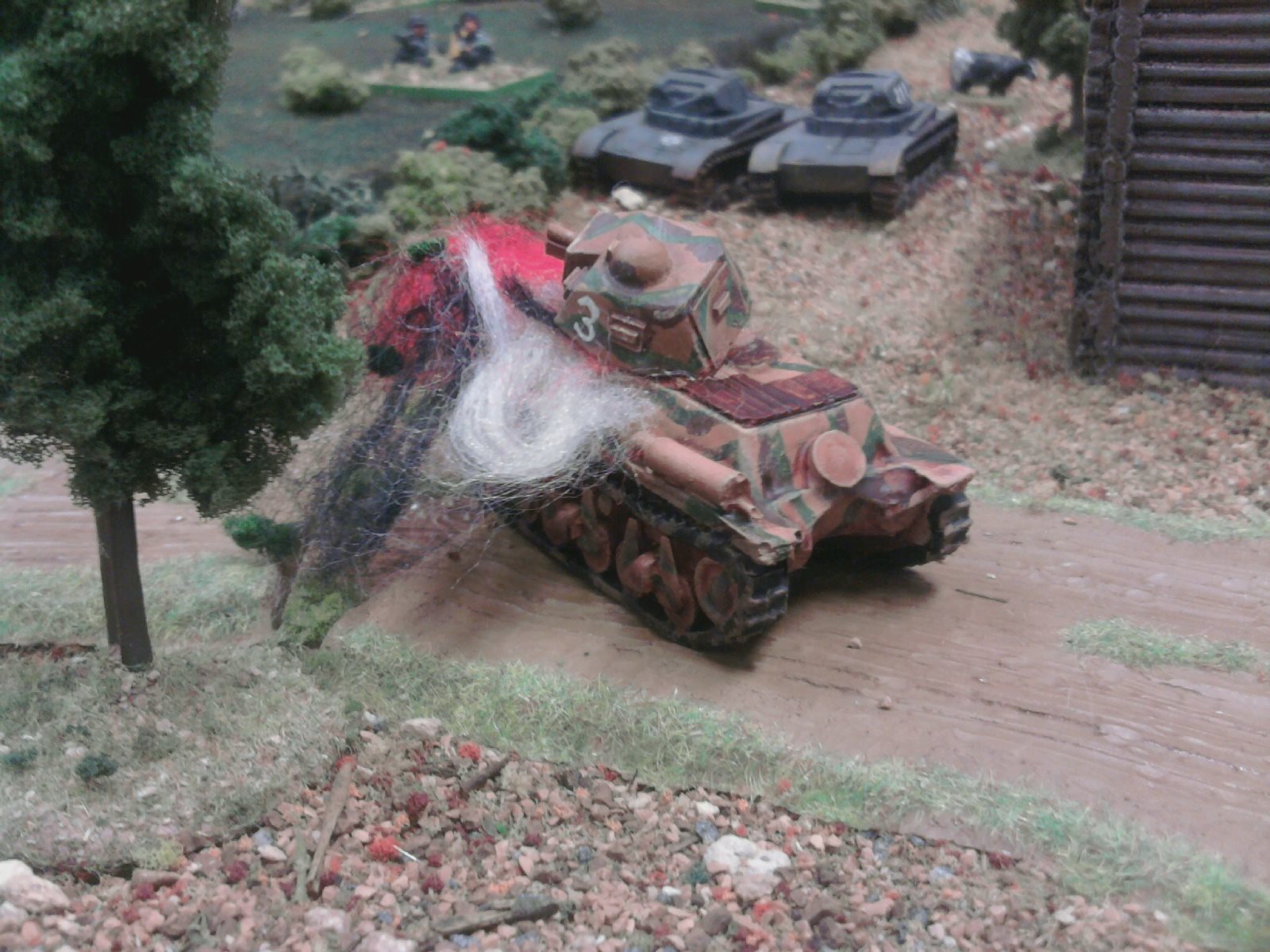
British Cromwell hunts Whittman!

British Cromwell hunts Whittman!
A pic from a Fireball game at Fall In 2010

Thursday, October 21, 2010

Fireball Forward at Fall In

Fall In will be at the Lancaster Host Resort next weekend (Oct 30) and there will be eight Fireball Forward games being run by a variety of people. Curt Daniels will be running three Russia '41 games that feature man vs tank actions from one of the Skirmish Campaigns books, Joe Seliga will do a Sicily '43 game featuring US paras and the Herman Goering Division, Sean Barnett will be running two Normandy games...including Michael Whittman's famous assault on the 7th Armoured Division at Villers Bocage and I will run a Normandy game featuring 10 Panthers and a Sicily game about Capt. Sayers attack on a fortified Italian HQ.

My Sicily game will have a dedicated terrain board that came out quite nice. Here are a few pics! Looking forward to seeing everyone at Fall In!


Monday, September 20, 2010

France 1940 - Fireball Game

Well the armor rules are finally set! It took alot of back and forth, testing, experimenting and input from alot of great people...but we are there! The rules are first of all...fun. Everyone seems to agree that what we came up with is fun to play giving the game a nice level of excitement. On top of that the results basically match the results you would get from Squad Leader, so we know we should not get any funky outcomes. The mechanics are fairly simple: a shooting tank rolls 1d6 and two range dice. The range dice depend on the gun type that is shooting. Shooter needs a 4+ on the d6 modified by the range dice and a list of the other modifiers. (which everyone will remember after the first game). If a hit is scored the target rolls d6s equal to its armor to save against the penetration value of the gun. It is fairly simple and after the first game everyone has it down pat.

The main issue we discovered while developing this set of WW2 rules is that there is a big difference between developing infantry rules and armor rules. Infantry forces across the globe in WW2 all used the same basic tactics and the same basic weapons: fire & manuever with machine gun, mortars and small arms. Countries had different organizations, slightly different weapons and different doctrines but these can all be accounted for easily in a comprehensive set of rules. Armor rules are radically different because you are actually modeling an arms race. This arms race at times has combatants on an even playing field and at other time with one side having a huge advantage in equipment. We found that modeling that correctly and having it work with the infantry rules to be the biggest challenge ...also keeping the rules simple and fun added to the challenge. But I feel we have succeeded.

To give these rules a real test we felt that gaming armor combat in France 1940 would be a supreme test. In that theater of war the French had tanks that were slow, moderately well armed and heavily armored while the German armor was lightly armored, fast and under-gunned. We played the scenario 'Road to Beaumont' from the Skirmish Campaigns book France 40 - The Ghost Division. It features Pzkfz 38t and PzIIs vs. H39s.

The game started with French Infantry moving through a woods to scout out the road ahead.


German infantry engaged the French and although they managed to keep most of them at bay one squad managed to find the Pz38ts and the H39s burst over the hill they were hiding behind and engaged them.. A group of a local farmer's sheep scurried out of way of the action!


The French destroyed a Pz38t and feeling that the way was clear a second, much larger group of H39s appeared and decided to barrel down the road and try to exit the board (thus achieving their victory condition...which was to escape Rommel's closing trap.) But to their surprise two PzIIs hit them in the flank and after a spirited fight took out an H39.


The French decided to make a run for it. Although they outnumbered the Germans they felt that their superior armor would protect them and their best chance for victory lay in advancing past the ambush. They pushed on with the PZIIs right behind them.


Although the French managed to take out a PZII they were overwhelmed and the last H39 was destroyed just as it was about to exit. It was tough for the Germans but superior tactics led them to victory.


The game worked very well and a good time was had by all. The armor rules played out great as the French tanks seemed tough to kill but not as effective as the Germans especially if they were moving. It could have gone either way and the results seemed to fit the historical narrative. We will be doing more France 40 and soon...Guadalcanal...not to mention North Africa.

Mark

Friday, August 20, 2010

A few good Fireball pics...


Jerry Frazee and his band of gamers in Charlotte, NC have been having fun playtesting Fireball Normandy scenarios from the Panzer Lehr book. Their observations and comments on the evolving rules have been invaluable! Jerry's figs are fantastic and his games always look nice. Here are a few pics that he shared with me. They show the dogfaces of the 30th and 9th divisions fighting off the Panthers of Panzer Lehr. Ben Gazzara would be proud!

Thursday, August 12, 2010

Early War Soviets...

Recently, we have begun to play some early war Russian Front scenarios. (Converting scenarios from the Skirmish Campaigns Ukraine book.) The big reason we have jumped into this was to test out the new armor rules with early war tanks. We are tinkering with the 'low end' guns, ie. 37mm AT guns vs. heavy tanks like the Char-B and the T-34. But it has turned out that we actually found this to be a great opportunity to work on modeling the command and control structure of the early Red Army. The German Army and Red Army were quite different and we found that by just changing the 'morale' values of the the forces that that alone did not give players the feel of the two opponents. The Germans were more tactically flexible and had better command...which made up for the fact that some of their weapons, like the 37mm or 50mm, had a hard time dealing with the Soviet heavy tanks. The Soviets on the other hand were rigid in their operations and often found their tactical choices dictated by incompetent Political Commissars.

We thought about this and decided to try two simple changes for 1941-42 Soviets. First: Their activation cards are assigned to particular units before play starts. Those units can only activate when their card is pulled. The Germans activate as normal; meaning any German unit can activate on any back card that is pulled. This severly hampers the Soviet flexibility while comparatively giving the Germans better flexibility. It forces the Soviet players to be more straight forward in their offensive actions.

Second: The Soviets in 1941-42 do not get initiative chips. Instead the can get a Commissar. He is a leader who can attach to a unit and try to motivate it. He does this by rolling on a Commissar Table (created by Jerry Frazee and Tom Poston from Fireball South in Charlotte, NC...thanks!) The table tells you what happens...everything form the troops mutiny (don't roll snake-eyes!) - to forcing the troops to assault - to overwhelming inspiration where the sons of Mother Russia surge forward. Everyone has really loved this Commissar rules as it adds great chrome and a real feel for early Soviets.

Overall we are really happy with these rules. They are simple and don't add any new die roll modifiers are overly complex rules...but really give the feel of early Soviets. The rules also make Germans feel that much better in comparison...and we did not have to add one extra rule about the Germans to achieve that!

For Fall In I am going to be running a Sicily scenario from CB Stevens 'Combat Jump Sicily' Skirmish Campaigns Scenario book. It has Italians....now I will be thinking how to model the Italian army!

Mark

Tuesday, July 13, 2010

Historicon Report

Historicon 2010 proved to be a great testing ground for Fireball Forward. Overall, eight games were run over the course of the weekend; seven Normandy scenarios and one Hue City. Everyone seemed to have fun, the games were close and some rules got hashed out in the process. I am really pleased as the goal of creating a game that is fast paced and fun seemed to play out. Most people had not played before but were able to learn the rules fairly quickly...and several of them returned to play multiple games.

There were two rules that got worked out that players universally thought did not 'feel' right. The first was the diameter of artillery barrages. I had it at 24-inches, which was way too big. A diameter of 12-inches should work just fine. That was my fault as I was thinking 12-inches all along but I kept saying radius instead of diameter. Other than that everyone loved the arty rules. During one game the Americans squeezed 2+ infantry platoons into a field when it got hit by 81mm mortars. They all broke and fled back to cover. It felt right and no one...including the US players thought it an unreasonable result.

The second rule that we worked on was how tanks conduct opportunity fire. The way we had been doing it was that tanks could rotate their turrets a certain number of degrees and if the gun pointed at the target then they could fire. This just didn't work as it kept leading to situations that didn't seem right...mainly because players felt that in many situations a tank could not see the target, ie. infantry creeping up to assault the tank. After alot of discussion we came up with a solution that we are trying that not only works better but is more in line with the general feel of the rules. Basically a tank with a tree-man turret (US and German) can take opportunity fire at a target that is either in the front 180-degrees of the front of the tank or within 180-degrees of the front of where the turret is pointed. A tank with a one or two man turret can only take opportunity fire a target in the front 180 of the turret. The idea is that these are the areas were the crew is focused. Seems simple, easy and addresses a host of issues.

Other than those two issues people mainly commented on what kind of variations they would use. The main rules...especially the armor rules seemed solid and well liked.

We'll be doing more games soon and I will let you know how things go. My wife and I have just moved to a new house and once we dig ourselves out I will be painting up figs to try out Guadalcanal...and see how the differences in terrain and tactics will change the rules! I want to tackle the Pacific BEFORE we release the rules. It has been my experience that most WW2 rules make everything work for Europe and Russia but not the Pacific.

Mark

Tuesday, June 22, 2010

Fireball Forward at Historicon 2010

If you're headed to Historicon this year there will be plenty of 'official' and 'un-official' Fireball games being run. I am running all three scenarios covering the 2nd SS Engineer's counterattack on July 9 and Jerry Frazee is running a couple of the Panther Battalion's counterattack. All of very fun and exciting games.

I will also be running a scenario of the American final assault on the ridge at Haut Vent using Tom Ballou's custom built terrain board...should be a nice piece of eye-candy. This game is not listed in the program and I am not sure when we will run it but if you're interested drop me a note at: mfastoso@aim.com

Besides these games I am sure will will run other pick up games. Maybe Jonathan will even bring his gorgeous Hue City terrain. Stop in, play and let me know what you think of the rules.

See you there!

Mark

Thursday, June 3, 2010

Artillery Rules...and the Hurtgen Forest

Well...as difficult as it has been to nail down the armor combat rules, which it looks like we finally did, the artillery rules have come together very quickly. We tried them out in two playtests of the second scenario in the Hurtgen Forest: Kall Trail scenario book.

Basically, there are a few types of artillery missions: interdiction, on-call fire, registration and prep fire. Except for interdiction they are all more or less played the same way with slight variations. Interdiction represents artillery fire being used behind the enemy's front lines to impede his progress, resupply, hinder reinforcements, etc. This is represented by a player using his interdiction artillery mission to prevent the opposing player from using 'initiative chips.' It works well...basically to slow down the enemy's advance. The other missions have an FO or company commander pick a target point and make a morale check...if they pass then they roll on the artillery chart. The artillery chart is the key. You roll 2d6 and the chart tells you what happens.

The idea behind this is we do not want (or feel we need) to model the entire procedure for calling in off board artillery. Basically you order that fire be placed on a target and there is a dramatic event...or not. The chart gives a storyline as well as a result so you know what happened. For example if you roll a 5 the result is:

5 Hello??? Hello??? - Armor moving through the area has run over telephone lines interrupting communications. The FO struggles to get is his request through.

No effect – the fire mission is NOT expended and may be used on a following turn.

Our feeling is that the game is about tactics and simple rules...not complex procedures for very technical operations. Artillery is dramatic and possibly decisive on the battlefield. American Artillery which is the best in WW2...imho...has a success on a 7+ with a 6 being possibly good. 4-5 are nothing and 2-3 are bad results.

After a few playtests everyone loves it.

We played a scenario from the Hurtgen book with lots of US artillery. The game was the German assault on Kommerscheidt, which is also an old GI Anvil of Victory scenario. The German armor commander wrote that he attacked the town but kept waiting for the infantry to follow him...they never did. He finally reached his objective and still the infantry never showed up so he retreated. As the American account of the fight mentions the liberal use of artillery it was decided that we would give the Germans infantry but also give the US plenty of artillery. The result was what we had expected. The US artillery compounded with alot of open ground allowed the US player to chew-up the German infantry. Although they made progress it was slow and costly.

So..it seems like the big three elements of the rules are finally shaking out! Infantry, Armor and Artillery all seem to be very close to working!

Mark